STEM at home
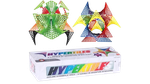
HyperTiles
Ages: 5+ years
HyperTiles are a construction set built around hyperbolic paraboloid geometry, a real mathematical concept that makes each tile flex, hinge, and combine in ways that cannot be scripted in advance. The set includes 48 tiles and 80 connectors. There is no instruction booklet leading to a single answer; every build is self-directed and every configuration emerges from the child's own choices. The inventor spent 36 years teaching high school science, and that shows: the math is genuine, not decorative. A Deluxe Set is also sold through the National Museum of Mathematics gift shop.
One honest note: the experience deepens with co-play. This is not a drop-it-and-walk-away toy at the lower end of the age range. It opens up when a curious adult builds alongside.
Why we like it: Because there is no right answer, children develop the habit of treating unexpected results as data rather than failure. That is spatial reasoning and iterative thinking in the same motion.
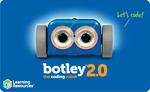
Botley 2.0 the Coding Robot
by Learning Resources
Ages: 5+ years
Botley is a screen-free coding robot that teaches the logic behind real programming: sequencing, loops, and conditional if/then reasoning through physical play, no screen required. Using a handheld remote programmer, children input a command sequence, transmit it, and watch Botley execute. When Botley takes a wrong turn, the child has to figure out where the code went wrong. That debugging loop mirrors how programmers actually think. The 2.0 version programs up to 150 steps in six directions and adds light and music coding modes. It comes with obstacle pieces, coding cards, and a progressive starter guide.
Awards: The original Botley was named Innovative Toy of the Year at the 2019 Toy of the Year Awards.
Why we like it: Botley builds the habit of thinking in sequence: plan all steps before acting, then observe carefully enough to trace what went wrong. That forward-planning and error-tracing is what algorithmic thinking looks like before a child ever touches a keyboard.

Cubetto+
by Primo Toys
Ages: 3-6 years
Cubetto+ is a screen-free wooden coding robot that teaches sequencing, directionality, and subroutine logic without a screen, app, or literacy. Its 24 color-coded blocks each represent a command. Children arrange them on a board, press a button, and watch the robot execute the program. When wrong, Cubetto+ moves the wrong way and the child can trace the sequence and fix it. The kit includes an adventure map and storybook; a teacher-developed curriculum with lesson plans extends play further. Storybooks in ten languages support multilingual families.
Why we like it: The physical design requires children to debug their own code. When the robot moves wrong, fixing it means tracing back through the sequence to locate the error. That is logical reasoning built through repetition, not instruction.
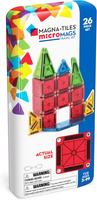
MAGNA-TILES microMAGS 26-Piece Travel Set
Ages: 3+ years
A pocket-sized version of the magnetic tile format most parents already know, built for travel. The 26-piece set uses the same geometry as a full set (squares, right and isosceles triangles, equilateral triangles) but at 75% smaller. The metal tin doubles as a building baseplate and fits in a bag pocket, making it useful on a plane, at a restaurant, or anywhere low-setup screen-free activity is needed. Pieces are fully compatible with standard sets. Best understood as a travel companion to an existing collection; the piece count is limited for extended independent building. The smaller tiles may not suit very young children still developing pincer grip.
Why we like it: No instructions come in the box. Children decide what to build, how to start, and what to do when a structure falls apart. That loop of planning, testing, and revising is exactly the spatial and logical reasoning that open-ended construction play builds.

The OffBits
Ages: 6+ years
Actual nuts, bolts, and springs come in the box alongside proprietary connectors and an illustrated instruction manual guiding builders through at least three named models per kit. Kits span robots, vehicles, animals, and transportation shapes. What separates this from a standard construction set is cross-compatibility and a design that rewards iteration: once the instructions are done, the pieces come apart and something new goes together. The brand encourages pulling in cardboard and household scraps to extend builds. Assembly demands real fine motor effort and spatial reasoning; younger builders will likely need adult help on the first model.
Awards: Mom's Choice Award Gold (2020); Parents' Choice Award; 2024 National Parenting Products Award.
Why we like it: The design intent is iteration, not completion. There is no finished product to display; there is only the next version. That is exactly the engineering mindset worth building early.
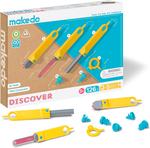
Makedo Cardboard Construction Tools
Ages: 5+ years
A set of child-safe, reusable tools (Safe-Saw, Scru-Driver, Fold-Roller, and plastic fasteners called Scrus) for cutting, folding, and connecting upcycled cardboard into whatever a child decides to build. No instructions, no predetermined outcome, no single right answer. A child supplies the idea; the tools supply the means. Building material is cardboard you already have. Complexity scales: a younger child builds a mask; an older one engineers a drawbridge with working hinges. Sized for small hands and meeting international safety standards.
Awards: Parents' Choice Recommended; STEM.org Authenticated; Dr. Gummer's Good Play Guide Recommended
Why we like it: Makedo builds iterative design thinking concretely. When a structure fails, the Scrus come out, cardboard gets repurposed, and the child figures out why it failed and what to change. That is the engineering design cycle, without anyone calling it that.
KEVA Planks
Ages: 5+ years
Every plank is the same size. No connectors, no sorting, no instructions. Just wooden blocks and whatever your child decides to build. When a tower falls, gravity delivered the feedback, not a parent. The child adjusts, rebuilds, tries again. Used in science museums and classrooms worldwide since 1992. The base sets are open-ended; the Contraptions line adds ball runs for guided builds, and Brain Builders introduces puzzle cards with specific 3D targets. The flagship sets are milled from American maple. KEVA Structures offers the same core experience in pine at a lower price point.
Awards: Oppenheim Toy Portfolio Platinum Seal 2025; NAPPA National Parenting Product Award 2025; Family Choice Award 2025
Why we like it: The single-shape, no-connector design forces spatial reasoning at its most honest. Balance, proportion, and structural load are all tested by actual gravity on every attempt. There is no forgiving snap to hold a bad build together.
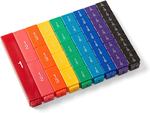
Rainbow Fraction Tower® Cubes
by hand2mind
Ages: 8-12 years
Fractions stay abstract for a long time. These interlocking cubes make them physical: because each cube is proportionally sized to its fraction value, snapping four one-quarter pieces together produces a tower exactly as tall as the whole. Equivalency stops being something to memorize and becomes something a child can see and test. The set covers nine fraction values, from whole to twelfths, and extends into operations including addition and subtraction with unlike denominators. No activity guide is included. This works best when an adult comes prepared with questions. Hand2mind offers free facilitation resources on its site. Worth noting: the Fraction Tower Equivalency Cubes, which add decimal and percent labeling, are sold at the same price and may be the better buy.
Why we like it: The 3D format does something flat tiles cannot: it makes equivalency physically testable. A child building and comparing towers is developing proportional reasoning, not just pattern recognition.
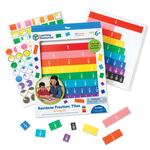
Rainbow Fraction Tiles with Tray
by Learning Resources
Ages: 6+ years
Fractions trip up a lot of kids because the math is invisible. You can tell a child that two-fourths equals one-half, but until they hold the pieces side by side and see it, the idea stays abstract. That is where this set earns its place. The 51 color-coded, proportional plastic tiles cover the standard fraction curriculum from halves through twelfths. The proportional sizing is the key feature: pieces physically match their values, so a child can line up three 1/3 tiles against the whole and watch the relationship become concrete. A plastic tray keeps everything organized, and a teaching guide is included. This is a classroom staple that works equally well at the kitchen table, especially when a parent is on hand to pose follow-up questions.
Why we like it: The proportional design pushes a child to reason about equivalency rather than memorize it. When they ask why two different tile combinations fill the same space, that is genuine mathematical thinking happening.

Infento Kits (Adventure / Innovator / Volt / Ultimate)
Ages: 4+ years
Infento kits let families build life-size, rideable vehicles from aluminum profiles, connectors, and fasteners, assembled with a hex key. Four tiers (Adventure, Innovator, Volt, and Ultimate) range from walkers and balance bikes to go-karts and electric quads, sharing one parts library so builds scale over years. Each kit includes manuals; the system supports open-ended design when your child is ready. First builds take real adult time and the assembly is genuinely complex. Families who embrace that consistently describe it as a multi-year project.
Awards: Red Dot Design Award (2018); German Design Award; Parents' Choice Gold Award
Why we like it: A vehicle assembled incorrectly won't roll right. That mechanical feedback builds structural reasoning and iterative troubleshooting in a way no worksheet can. Children learn to read technical diagrams, sequence steps, and stay with a problem through the hard middle. Those habits translate directly to engineering and physics thinking.