STEM at home
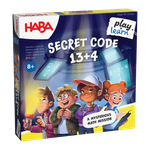
Secret Code 13+4
by Haba
Ages: 8+ years
Secret Code 13+4 is a fast-play arithmetic board game for 2 to 4 players. Each turn, players roll six dice and must combine the results using addition, subtraction, multiplication, or division to hit a target number and advance on the board. The twist: the answer is given first. Your child has to work backwards, evaluating multiple equation paths before choosing the most efficient one. Simpler moves are always available for less advanced players, making mixed-skill family play genuinely workable rather than frustrating.
Why we like it: Most arithmetic practice asks kids to solve forward -- here comes the equation, find the answer. This game does the opposite: here comes the answer, build the equation. That reversal trains flexible mathematical reasoning, the kind that shows up in algebra long before your child gets there.

Bill Nye Home Demos
Ages: 9-13 years
The Home Demos section of billnye.com offers around 40 free, printable experiments tied to episodes of Bill Nye the Science Guy. Organized into Life Science, Physical Science, and Planetary Science, they cover genuine topics: surface tension, acid erosion, buoyancy, atmospheric pressure, momentum, and ocean currents. Every experiment uses household materials and includes a "What's Happening?" section that explains the underlying science in accurate, specific terms. "Acid Attack" correctly names calcium carbonate, explains the reaction with acid, and connects it to acid rain. The site has not been visibly updated since the 1990s, but the science holds up.
Why we like it: Most at-home activities give steps and a result. These give the mechanism. A child working through "Mold Madness" over several days, comparing outcomes across conditions, is practicing the observational reasoning scientists actually use — asking not just what happened, but why.

HyperTiles
Ages: 5+ years
HyperTiles are a construction set built around hyperbolic paraboloid geometry, a real mathematical concept that makes each tile flex, hinge, and combine in ways that cannot be scripted in advance. The set includes 48 tiles and 80 connectors. There is no instruction booklet leading to a single answer; every build is self-directed and every configuration emerges from the child's own choices. The inventor spent 36 years teaching high school science, and that shows: the math is genuine, not decorative. A Deluxe Set is also sold through the National Museum of Mathematics gift shop.
One honest note: the experience deepens with co-play. This is not a drop-it-and-walk-away toy at the lower end of the age range. It opens up when a curious adult builds alongside.
Why we like it: Because there is no right answer, children develop the habit of treating unexpected results as data rather than failure. That is spatial reasoning and iterative thinking in the same motion.
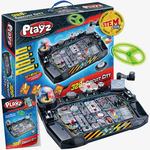
Playz Advanced Circuit Kit
Ages: 8-13+ years
A hands-on electronics kit that lets kids build working circuits from scratch, exploring concepts like voltage, current, resistance, and magnetism across 328 guided experiments. Projects range from simple LED connections to an AM/FM radio and a fan motor, with a 64-page illustrated manual walking through each build. The experiments scale in complexity, so there is room to grow as confidence builds. Some parental involvement during setup is worth planning for, particularly with younger builders.
Why we like it: The kit teaches kids to read a circuit diagram, form a hypothesis about what will happen when connections change, and then test it, which builds the kind of systematic reasoning that carries into physics and engineering well beyond this kit.

Circuit Scribe Inventor Kits
Ages: 8+ years
Circuit Scribe Inventor Kits teach real electronics using a conductive ink pen that draws circuits directly on paper. No soldering, no wiring, no breadboard. Each kit pairs the pen with magnetic modules (LEDs, buzzers, motors, switches) and an Inventor's Notebook covering fundamentals from conductivity and blinking circuits to transistors, inputs, and outputs. Once the workbook is done, the system opens up: modules are reusable and circuits can be rebuilt as many times as your child wants. Free lessons and live workshops with engineers extend the learning. Honest note: the pen has a learning curve, and younger beginners benefit from adult coaching early on.
Awards: Creative Child Magazine Product of the Year
Why we like it: The workbook structures learning around the engineering design process. Kids build a circuit, watch it fail, and figure out why. That troubleshooting habit is one of the most transferable thinking skills in STEM, and this kit builds it on purpose.
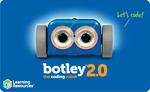
Botley 2.0 the Coding Robot
by Learning Resources
Ages: 5+ years
Botley is a screen-free coding robot that teaches the logic behind real programming: sequencing, loops, and conditional if/then reasoning through physical play, no screen required. Using a handheld remote programmer, children input a command sequence, transmit it, and watch Botley execute. When Botley takes a wrong turn, the child has to figure out where the code went wrong. That debugging loop mirrors how programmers actually think. The 2.0 version programs up to 150 steps in six directions and adds light and music coding modes. It comes with obstacle pieces, coding cards, and a progressive starter guide.
Awards: The original Botley was named Innovative Toy of the Year at the 2019 Toy of the Year Awards.
Why we like it: Botley builds the habit of thinking in sequence: plan all steps before acting, then observe carefully enough to trace what went wrong. That forward-planning and error-tracing is what algorithmic thinking looks like before a child ever touches a keyboard.

Cubetto+
by Primo Toys
Ages: 3-6 years
Cubetto+ is a screen-free wooden coding robot that teaches sequencing, directionality, and subroutine logic without a screen, app, or literacy. Its 24 color-coded blocks each represent a command. Children arrange them on a board, press a button, and watch the robot execute the program. When wrong, Cubetto+ moves the wrong way and the child can trace the sequence and fix it. The kit includes an adventure map and storybook; a teacher-developed curriculum with lesson plans extends play further. Storybooks in ten languages support multilingual families.
Why we like it: The physical design requires children to debug their own code. When the robot moves wrong, fixing it means tracing back through the sequence to locate the error. That is logical reasoning built through repetition, not instruction.
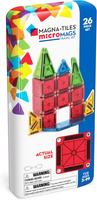
MAGNA-TILES microMAGS 26-Piece Travel Set
Ages: 3+ years
A pocket-sized version of the magnetic tile format most parents already know, built for travel. The 26-piece set uses the same geometry as a full set (squares, right and isosceles triangles, equilateral triangles) but at 75% smaller. The metal tin doubles as a building baseplate and fits in a bag pocket, making it useful on a plane, at a restaurant, or anywhere low-setup screen-free activity is needed. Pieces are fully compatible with standard sets. Best understood as a travel companion to an existing collection; the piece count is limited for extended independent building. The smaller tiles may not suit very young children still developing pincer grip.
Why we like it: No instructions come in the box. Children decide what to build, how to start, and what to do when a structure falls apart. That loop of planning, testing, and revising is exactly the spatial and logical reasoning that open-ended construction play builds.

The OffBits
Ages: 6+ years
Actual nuts, bolts, and springs come in the box alongside proprietary connectors and an illustrated instruction manual guiding builders through at least three named models per kit. Kits span robots, vehicles, animals, and transportation shapes. What separates this from a standard construction set is cross-compatibility and a design that rewards iteration: once the instructions are done, the pieces come apart and something new goes together. The brand encourages pulling in cardboard and household scraps to extend builds. Assembly demands real fine motor effort and spatial reasoning; younger builders will likely need adult help on the first model.
Awards: Mom's Choice Award Gold (2020); Parents' Choice Award; 2024 National Parenting Products Award.
Why we like it: The design intent is iteration, not completion. There is no finished product to display; there is only the next version. That is exactly the engineering mindset worth building early.
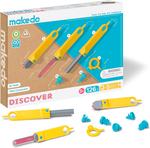
Makedo Cardboard Construction Tools
Ages: 5+ years
A set of child-safe, reusable tools (Safe-Saw, Scru-Driver, Fold-Roller, and plastic fasteners called Scrus) for cutting, folding, and connecting upcycled cardboard into whatever a child decides to build. No instructions, no predetermined outcome, no single right answer. A child supplies the idea; the tools supply the means. Building material is cardboard you already have. Complexity scales: a younger child builds a mask; an older one engineers a drawbridge with working hinges. Sized for small hands and meeting international safety standards.
Awards: Parents' Choice Recommended; STEM.org Authenticated; Dr. Gummer's Good Play Guide Recommended
Why we like it: Makedo builds iterative design thinking concretely. When a structure fails, the Scrus come out, cardboard gets repurposed, and the child figures out why it failed and what to change. That is the engineering design cycle, without anyone calling it that.