STEM at home

ChessUp 2 Smart Chess Board
by Bryght Labs
Ages: 7+ years
Chess is hard to learn, and that's the problem ChessUp 2 is built to solve. Touch sensors and LEDs in every square light up legal moves the moment a piece is lifted. Color coding shows move quality, and assistance can be dialed down or off entirely as skill develops. The companion app syncs with the board so lessons play out physically, and connects to Chess.com for rated play without a phone on the table.
At around $350, this is a real investment. It earns that price for families where a child has shown genuine interest in chess, or where the board will see repeated use. If you are testing whether chess clicks at all, a standard set and a free app is the smarter starting point.
Why we like it: Chess trains the habit of holding multiple outcomes in mind and revising a plan when new information arrives. The board's adjustable scaffolding keeps that cognitive work intact while removing the legal-move memorization barrier that stops most beginners before they reach actual strategy.

Spintronics
by Upper Story
Ages: 8+ years
Circuits are invisible until you build one. Spintronics changes that. Players construct mechanical circuits using sprocketed gears, chains, and components representing batteries, resistors, capacitors, and switches. The chains stand in for wires; a pull cord drives the current. When it works, you see it. When it doesn't, you see that too. Act One covers core electrical engineering across 67 puzzles and is the required starting point. Act Two, sold separately, adds transistors and inductors with 82 more puzzles from intermediate to advanced. A free simulator is available on the Upper Story site.
One honest flag: the chain links are small and fiddly. Adult co-play is realistic for younger children.
Why we like it: Spintronics builds causal reasoning about circuits, requiring children to predict how a configuration will behave, test it, and adjust. The feedback is immediate and physical, not abstract. That loop of hypothesis and revision is how engineers actually think.

ChompSaw by Chompshop
Ages: 5+ years
Cardboard is everywhere, and your child has probably looked at a box and imagined something better. The problem has always been the cutting. The ChompSaw by Chompshop lets kids cut cardboard on their own, using a hole-punch mechanism instead of a blade, with an opening too small for fingers. It handles straight lines, curves, and shapes through cardboard, craft foam, and fabric, on a work surface with built-in measuring and angle guides. One honest note: the tool is loud, so noise-sensitive children may want ear protection. The Inventor's Club subscription (sold separately) adds monthly guided project packs.
Awards: TIME Best Inventions 2025; TOTY Creative Toy of the Year 2026
Why we like it: Once a child can cut cardboard on their own, the design loop closes. They plan a structure, build it, see where it fails, and try again without waiting for help. That cycle of spatial planning, iteration, and physical problem-solving is where engineering thinking gets built.

Picasso Tiles Building Blcoks with Car and Carry Bag
Ages: 3+ years
Translucent geometric pieces that connect along their edges and give a child complete freedom over what comes next. No instructions, no set outcome. Kids build towers, ramps, and enclosures; knock them down; rebuild with more ambition. Screenless, tactile, replayable.
Weighing these against Magna-Tiles: formats are compatible and the experience is similar. The main difference is price. These run about three times more tiles per dollar, which matters when building a large set. Build quality is slightly lower (glue bonding rather than riveted, marginally weaker magnets), but parents report years of use without issue.
No curriculum or challenge cards. Value comes entirely from the child's own building, not an instructional layer.
Why we like it: Free building with magnetic tiles builds spatial reasoning and geometry intuition through cause and effect. When a structure collapses, a child gets direct feedback on load, balance, and polarity. That feedback loop is the lesson.

National Geographic Magnetic Marble Run
by Blue Marble
Ages: 10+ years
Build a marble maze on your fridge. With 75 pieces — magnetic tracks, connectors, and trick pieces like funnels, spinners, and catapults — this set turns any vertical magnetic surface into a hands-on engineering experiment. Kids design a course, test it, watch what happens, and rebuild. The included Learning Guide connects the play to real physics: gravity, motion, and chain reactions. Less floor clutter, more figuring things out.
Why we like it: The vertical, magnetic format removes the usual setup barrier — no floor sprawl, no frustrating reassembly. The design-test-redesign loop is genuinely built into the play, not just claimed on the box. Kids who need to move things to understand them will find this hard to put down. Good Play Guide testers noted it works just as well in pairs as solo, which makes it a rare find for collaborative building play at home.
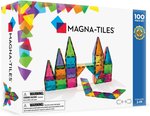
Magna-Tiles Classic 100-Piece Magnetic Construction Set
by Magna-Tiles
Ages: 3-99 years
One hundred magnetic tiles in bright, translucent colors — squares, triangles, and more — that snap together to build just about anything a child can imagine. Towers, animals, geometric shapes, sprawling structures: the only real limit is the floor space. Tiles are sized and weighted for young builders, with magnet strength that holds without frustrating. Each build quietly practices spatial reasoning, geometry, and problem-solving.
Why we like it: Magna-Tiles have earned their reputation the old-fashioned way: kids keep coming back to them. The 100-piece set hits a sweet spot — enough pieces to build ambitiously, with the same satisfying click that makes even the simplest structure feel like an achievement. They work just as well solo as they do with a sibling on the other side of the floor. A genuine STEM at Home staple.
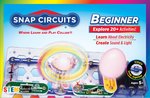
Snap Circuits Beginner: Electronics Explorations Kit
by Snap Circuits
Ages: 5-9 Years
Fourteen color-coded parts that snap onto a plastic grid — no tools, no soldering. Kids follow illustrated diagrams to build more than 20 working electronics projects: a light-up fan, an alarm, a switch circuit. Each one is a real, functioning circuit with immediate, satisfying feedback. The manual is designed specifically for younger builders, with diagrams that make independent play genuinely possible.
Awards: Toy of the Year (TOTY) | Good Housekeeping's Best Toys | Parent's Choice Recommended | Seriously STEM Award | National Parenting Center Seal of Approval
Why we like it: This is one of the few kits where the learning and the play are genuinely the same thing. Kids aren't doing worksheets about circuits — they're building them, watching them work, and figuring out why they don't when something goes wrong. The beginner set is intentionally modest in scope, which is exactly right: it builds confidence before complexity. Most kids outgrow it wanting the next one up.