STEM at home
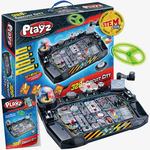
Playz Advanced Circuit Kit
Ages: 8-13+ years
A hands-on electronics kit that lets kids build working circuits from scratch, exploring concepts like voltage, current, resistance, and magnetism across 328 guided experiments. Projects range from simple LED connections to an AM/FM radio and a fan motor, with a 64-page illustrated manual walking through each build. The experiments scale in complexity, so there is room to grow as confidence builds. Some parental involvement during setup is worth planning for, particularly with younger builders.
Why we like it: The kit teaches kids to read a circuit diagram, form a hypothesis about what will happen when connections change, and then test it, which builds the kind of systematic reasoning that carries into physics and engineering well beyond this kit.
Circuit Scribe Inventor Kits
Ages: 8+ years
Circuit Scribe Inventor Kits teach real electronics using a conductive ink pen that draws circuits directly on paper. No soldering, no wiring, no breadboard. Each kit pairs the pen with magnetic modules (LEDs, buzzers, motors, switches) and an Inventor's Notebook covering fundamentals from conductivity and blinking circuits to transistors, inputs, and outputs. Once the workbook is done, the system opens up: modules are reusable and circuits can be rebuilt as many times as your child wants. Free lessons and live workshops with engineers extend the learning. Honest note: the pen has a learning curve, and younger beginners benefit from adult coaching early on.
Awards: Creative Child Magazine Product of the Year
Why we like it: The workbook structures learning around the engineering design process. Kids build a circuit, watch it fail, and figure out why. That troubleshooting habit is one of the most transferable thinking skills in STEM, and this kit builds it on purpose.
Botley 2.0 the Coding Robot
by Learning Resources
Ages: 5+ years
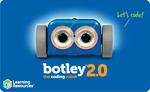
Botley is a screen-free coding robot that teaches the logic behind real programming: sequencing, loops, and conditional if/then reasoning through physical play, no screen required. Using a handheld remote programmer, children input a command sequence, transmit it, and watch Botley execute. When Botley takes a wrong turn, the child has to figure out where the code went wrong. That debugging loop mirrors how programmers actually think. The 2.0 version programs up to 150 steps in six directions and adds light and music coding modes. It comes with obstacle pieces, coding cards, and a progressive starter guide.
Awards: The original Botley was named Innovative Toy of the Year at the 2019 Toy of the Year Awards.
Why we like it: Botley builds the habit of thinking in sequence: plan all steps before acting, then observe carefully enough to trace what went wrong. That forward-planning and error-tracing is what algorithmic thinking looks like before a child ever touches a keyboard.

Cubetto+
by Primo Toys
Ages: 3-6 years
Cubetto+ is a screen-free wooden coding robot that teaches sequencing, directionality, and subroutine logic without a screen, app, or literacy. Its 24 color-coded blocks each represent a command. Children arrange them on a board, press a button, and watch the robot execute the program. When wrong, Cubetto+ moves the wrong way and the child can trace the sequence and fix it. The kit includes an adventure map and storybook; a teacher-developed curriculum with lesson plans extends play further. Storybooks in ten languages support multilingual families.
Why we like it: The physical design requires children to debug their own code. When the robot moves wrong, fixing it means tracing back through the sequence to locate the error. That is logical reasoning built through repetition, not instruction.

The OffBits
Ages: 6+ years
Actual nuts, bolts, and springs come in the box alongside proprietary connectors and an illustrated instruction manual guiding builders through at least three named models per kit. Kits span robots, vehicles, animals, and transportation shapes. What separates this from a standard construction set is cross-compatibility and a design that rewards iteration: once the instructions are done, the pieces come apart and something new goes together. The brand encourages pulling in cardboard and household scraps to extend builds. Assembly demands real fine motor effort and spatial reasoning; younger builders will likely need adult help on the first model.
Awards: Mom's Choice Award Gold (2020); Parents' Choice Award; 2024 National Parenting Products Award.
Why we like it: The design intent is iteration, not completion. There is no finished product to display; there is only the next version. That is exactly the engineering mindset worth building early.
Makedo Cardboard Construction Tools
Ages: 5+ years
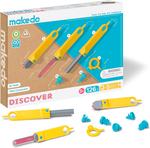
A set of child-safe, reusable tools (Safe-Saw, Scru-Driver, Fold-Roller, and plastic fasteners called Scrus) for cutting, folding, and connecting upcycled cardboard into whatever a child decides to build. No instructions, no predetermined outcome, no single right answer. A child supplies the idea; the tools supply the means. Building material is cardboard you already have. Complexity scales: a younger child builds a mask; an older one engineers a drawbridge with working hinges. Sized for small hands and meeting international safety standards.
Awards: Parents' Choice Recommended; STEM.org Authenticated; Dr. Gummer's Good Play Guide Recommended
Why we like it: Makedo builds iterative design thinking concretely. When a structure fails, the Scrus come out, cardboard gets repurposed, and the child figures out why it failed and what to change. That is the engineering design cycle, without anyone calling it that.

KEVA Planks
Ages: 5+ years
Every plank is the same size. No connectors, no sorting, no instructions. Just wooden blocks and whatever your child decides to build. When a tower falls, gravity delivered the feedback, not a parent. The child adjusts, rebuilds, tries again. Used in science museums and classrooms worldwide since 1992. The base sets are open-ended; the Contraptions line adds ball runs for guided builds, and Brain Builders introduces puzzle cards with specific 3D targets. The flagship sets are milled from American maple. KEVA Structures offers the same core experience in pine at a lower price point.
Awards: Oppenheim Toy Portfolio Platinum Seal 2025; NAPPA National Parenting Product Award 2025; Family Choice Award 2025
Why we like it: The single-shape, no-connector design forces spatial reasoning at its most honest. Balance, proportion, and structural load are all tested by actual gravity on every attempt. There is no forgiving snap to hold a bad build together.

Infento Kits (Adventure / Innovator / Volt / Ultimate)
Ages: 4+ years
Infento kits let families build life-size, rideable vehicles from aluminum profiles, connectors, and fasteners, assembled with a hex key. Four tiers (Adventure, Innovator, Volt, and Ultimate) range from walkers and balance bikes to go-karts and electric quads, sharing one parts library so builds scale over years. Each kit includes manuals; the system supports open-ended design when your child is ready. First builds take real adult time and the assembly is genuinely complex. Families who embrace that consistently describe it as a multi-year project.
Awards: Red Dot Design Award (2018); German Design Award; Parents' Choice Gold Award
Why we like it: A vehicle assembled incorrectly won't roll right. That mechanical feedback builds structural reasoning and iterative troubleshooting in a way no worksheet can. Children learn to read technical diagrams, sequence steps, and stay with a problem through the hard middle. Those habits translate directly to engineering and physics thinking.

Bridge or Bust: The Ultimate Bridge-Building Adventure
by Upper Story
Ages: 8+ years
Each of 61 challenges asks your child to build a bridge satisfying three simultaneous constraints: span length, load capacity, and clearance height for a sailboat to pass beneath. Those are actual structural engineering variables. The kit teaches them through testing and iteration, not instruction. When a bridge fails, the pieces snap back together in seconds. That fast reset is intentional: it removes the friction that usually punishes failure and makes iteration the natural rhythm of play.
One honest heads-up: initial setup requires attaching roughly 200 small clips before the first puzzle, which can take an hour or more. Plan for that. This kit also sells direct through the manufacturer only, with no Amazon presence.
Awards: NAPPA Awards Winner, 2026.
Why we like it: It trains the habit of holding multiple constraints in mind at once, which is closer to real engineering reasoning than most building kits get. Your child is not just building, they are learning to manage tradeoffs.

Turing Tumble
by Upper Story
Ages: 8+ years
A marble-powered mechanical computer built from ramps, bits, and gear bits, Turing Tumble teaches how computers work: no screen, no battery, no code. Players work through 60 puzzles woven into a comic-book story, building configurations that direct red and blue marbles in specified patterns. Puzzles introduce binary logic, if/else relationships, and iterative debugging, adding piece types as complexity grows. Developed by a former university professor with a programming background who built it to address his students' struggles with computational thinking.
Awards: 2018 Parents' Choice Gold Award; 2018 ASTRA Best Toys for Kids Award; 2019 Toy of the Year Finalist; NAPPA Award Winner
Why we like it: The puzzle structure mirrors real debugging. Build a configuration, run it, see what breaks, revise. Children practice forming a hypothesis about why a solution failed, then testing a fix. That loop is what computational thinking looks like in practice, and it transfers well beyond this board.