STEM at home

Spintronics
by Upper Story
Ages: 8+ years
Circuits are invisible until you build one. Spintronics changes that. Players construct mechanical circuits using sprocketed gears, chains, and components representing batteries, resistors, capacitors, and switches. The chains stand in for wires; a pull cord drives the current. When it works, you see it. When it doesn't, you see that too. Act One covers core electrical engineering across 67 puzzles and is the required starting point. Act Two, sold separately, adds transistors and inductors with 82 more puzzles from intermediate to advanced. A free simulator is available on the Upper Story site.
One honest flag: the chain links are small and fiddly. Adult co-play is realistic for younger children.
Why we like it: Spintronics builds causal reasoning about circuits, requiring children to predict how a configuration will behave, test it, and adjust. The feedback is immediate and physical, not abstract. That loop of hypothesis and revision is how engineers actually think.

Backyard Brains
Ages: 10+ years
These kits put real neuroscience into kids' hands. Devices in the product line record actual electrical signals from muscles, hearts, brains, and plants. The Human SpikerBox lets students visualize their own muscle and heart signals in real time. Other kits cover plant signaling, reflex testing, and neuroprosthetics. Each ships with free, grade-leveled experiment guides aligned to NGSS and AP frameworks. The science is not simulated: students record live data and design their own experiments. The line runs from entry-level kits to brain-computer interface experiments.
Awards: Champion of Change for Citizen Science (White House); Next Generation Award (Society for Neuroscience); NIMH Director's Award; 4 NIH research grants.
Why we like it: Most STEM kits teach kids about science. These ask them to practice it. The structure builds genuine hypothesis-testing: record a baseline, manipulate a variable, compare results. That's the scientific method, not a worksheet version of it.

ChompSaw by Chompshop
Ages: 5+ years
Cardboard is everywhere, and your child has probably looked at a box and imagined something better. The problem has always been the cutting. The ChompSaw by Chompshop lets kids cut cardboard on their own, using a hole-punch mechanism instead of a blade, with an opening too small for fingers. It handles straight lines, curves, and shapes through cardboard, craft foam, and fabric, on a work surface with built-in measuring and angle guides. One honest note: the tool is loud, so noise-sensitive children may want ear protection. The Inventor's Club subscription (sold separately) adds monthly guided project packs.
Awards: TIME Best Inventions 2025; TOTY Creative Toy of the Year 2026
Why we like it: Once a child can cut cardboard on their own, the design loop closes. They plan a structure, build it, see where it fails, and try again without waiting for help. That cycle of spatial planning, iteration, and physical problem-solving is where engineering thinking gets built.

MEL Science
Ages: 8+ years
MEL Science delivers monthly chemistry and physics kits that go well beyond craft-kit territory. The chemistry track ships certified reagents, Pyrex glassware, and real reactions: tin dendrites grown with electricity, hydrogen combustion, pH color changes. The physics track builds working models of everyday devices and explores electromagnetism and polarized light. Both tracks pair each experiment with a VR/AR app that lets kids visualize molecular structure or physical principles right after the lab. This is a co-pilot subscription: an adult works alongside the child, and that shared time is part of the design.
Gotham STEM recommends the Chemistry and Physics tracks only. The other available tracks operate at a different level of rigor.
Why we like it: After each experiment, the VR/AR layer asks kids to explain what happened at the molecular level, not just observe that it did. That shift from procedure to causal reasoning is where real scientific thinking takes hold.
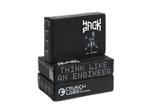
Crunch Labs Hack Pack Subscription
Ages: 14+ years
The Hack Pack is a bi-monthly subscription for teens and adults that goes beyond building into engineering iteration. Each box includes everything needed to construct a working robot-scale mechanism, such as a motion-sensing IR turret, a sand garden, or a password-protected candy vault, along with an Arduino microcontroller, power bank, and a browser-based coding console. The build comes first. Then comes the hacking: modifying the machine's behavior through code, working with servo motors, IR sensors, and embedded programming. Projects are designed to be extended and personalized, not just completed.
Awards: Good Housekeeping 2025 Toy Award.
Why we like it: Most STEM kits stop at assembly. Hack Pack starts there. When a teenager rewrites how a machine behaves after building it, they are practicing the iterative design loop that real engineers use: build, test, change, test again. That is a different cognitive skill than following instructions, and genuinely harder to find at home.
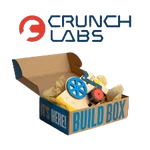
Crunch Labs Build Box Subscription
Ages: 8-12 years
The Build Box is a monthly subscription that delivers a working mechanism each month: a disc launcher, a drawing bot, a chain reaction machine. All parts, illustrated instructions, and a companion video from Mark Rober, a former NASA engineer, explaining the physics behind the build are included. Each project is anchored to a specific concept: momentum transfer, light refraction, mechanical advantage. Kids work through the build independently, and the video walks through both the how and the why. No extra materials needed.
Awards: Good Housekeeping 2025 Toy Award.
Why we like it: Each build connects a physical cause to an observable effect. A child who constructs a disc launcher and then watches Rober explain why angular momentum keeps it stable is doing more than following instructions. That cause-and-effect reasoning is the foundation of scientific thinking.

Green Kid Crafts
Ages: 3-10 years
Each month, a Green Kid Crafts box arrives with 4 to 6 hands-on STEAM projects built around a single theme: Backyard Science, Green Energy, Outer Space, and more. Founded by environmental scientist Penny Bauder, the subscription is designed around nature-based inquiry, using eco-friendly materials to draw connections between scientific thinking and environmental responsibility. Projects span science, engineering, art, and math, and every box includes a 12-page activity magazine with guided prompts that develop observation, hypothesis-testing, and creative problem-solving skills.
Awards: Parents' Choice Award; Academics' Choice Brain Toy Award; NCW Eco-Excellence Award; Red Tricycle Most Awesome Subscription Service Award.
Why we like it: Every theme is a framework for systems thinking. Kids aren't just making things, they're asking why materials behave the way they do and what that means for the world around them. The environmental lens makes the science feel real.
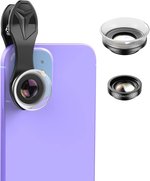
2-in-1 Phone Lens Kit (10x Macro + Wide Angle)
Ages: 5+ years
A clip-on macro lens that turns any smartphone into a field microscope. The universal clip fits most phones and cases, so your child can get close enough to spot moss spore structures, insect galls, and details the naked eye simply misses. Inexpensive, dead simple to use, and one of the best budget options in its class.
Why we like it: This is one of those tools that quietly changes how a child sees the world. Clip it on during a walk in the park or a weekend hike, and suddenly every log, leaf, and patch of moss becomes worth investigating. That's not a gadget. That's a gateway.
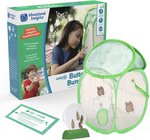
Geosafari Jr Butterfly Bungalow Science Kit with Live Caterpillars
by Educational Insights
Ages: 4+ years
Send in the included certificate, receive five live Painted Lady caterpillars, and watch what happens next. The mesh habitat lets kids observe every stage up close — larva, chrysalis, butterfly — with a magnifying glass to catch the details. An activity guide keeps the curiosity going with prompts and facts. Then release them. The whole cycle, start to finish, right at home. One of nature's most astonishing transformations, at a scale small enough to sit on your kitchen table.
Why we like it: There's no simulation here — this is the real thing. Watching an actual caterpillar become a butterfly is the kind of experience that lands differently than any book or video. The kit keeps it simple and accessible, and the raise-and-release structure gives even very young children a genuine sense of responsibility and wonder. Note: caterpillars arrive via mail-in certificate; shipping and handling fees apply.
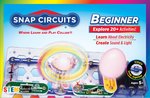
Snap Circuits Beginner: Electronics Explorations Kit
by Snap Circuits
Ages: 5-9 Years
Fourteen color-coded parts that snap onto a plastic grid — no tools, no soldering. Kids follow illustrated diagrams to build more than 20 working electronics projects: a light-up fan, an alarm, a switch circuit. Each one is a real, functioning circuit with immediate, satisfying feedback. The manual is designed specifically for younger builders, with diagrams that make independent play genuinely possible.
Awards: Toy of the Year (TOTY) | Good Housekeeping's Best Toys | Parent's Choice Recommended | Seriously STEM Award | National Parenting Center Seal of Approval
Why we like it: This is one of the few kits where the learning and the play are genuinely the same thing. Kids aren't doing worksheets about circuits — they're building them, watching them work, and figuring out why they don't when something goes wrong. The beginner set is intentionally modest in scope, which is exactly right: it builds confidence before complexity. Most kids outgrow it wanting the next one up.