STEM at home
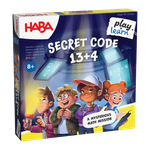
Secret Code 13+4
by Haba
Ages: 8+ years
Secret Code 13+4 is a fast-play arithmetic board game for 2 to 4 players. Each turn, players roll six dice and must combine the results using addition, subtraction, multiplication, or division to hit a target number and advance on the board. The twist: the answer is given first. Your child has to work backwards, evaluating multiple equation paths before choosing the most efficient one. Simpler moves are always available for less advanced players, making mixed-skill family play genuinely workable rather than frustrating.
Why we like it: Most arithmetic practice asks kids to solve forward -- here comes the equation, find the answer. This game does the opposite: here comes the answer, build the equation. That reversal trains flexible mathematical reasoning, the kind that shows up in algebra long before your child gets there.
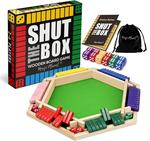
Shut the Box
Ages: 5+ years
Shut the Box started as a pub game, likely in 18th-century Normandy, and it has outlasted most things invented for entertainment since. Two dice, nine numbered tiles, and the goal of closing every tile before your luck runs out. The math is real: each roll requires figuring out which combination of open tiles adds up to your total. A roll of eight might close tiles 3 and 5, or 1 and 7, or just the 8 alone. That choice is the whole game. Number decomposition and mental addition happen on every turn, and the probability of pulling off a clean sweep is genuinely hard to calculate, which keeps it interesting well past the basics. The game works solo or with up to four players and packs flat for travel.
Why we like it: The real learning is in recognizing that most rolls have several valid solutions. Asking your child why they chose one tile combination over another turns a dice game into a genuine number reasoning conversation, which is harder to engineer than it sounds.

ChessUp 2 Smart Chess Board
by Bryght Labs
Ages: 7+ years
Chess is hard to learn, and that's the problem ChessUp 2 is built to solve. Touch sensors and LEDs in every square light up legal moves the moment a piece is lifted. Color coding shows move quality, and assistance can be dialed down or off entirely as skill develops. The companion app syncs with the board so lessons play out physically, and connects to Chess.com for rated play without a phone on the table.
At around $350, this is a real investment. It earns that price for families where a child has shown genuine interest in chess, or where the board will see repeated use. If you are testing whether chess clicks at all, a standard set and a free app is the smarter starting point.
Why we like it: Chess trains the habit of holding multiple outcomes in mind and revising a plan when new information arrives. The board's adjustable scaffolding keeps that cognitive work intact while removing the legal-move memorization barrier that stops most beginners before they reach actual strategy.

Bridge or Bust: The Ultimate Bridge-Building Adventure
by Upper Story
Ages: 8+ years
Each of 61 challenges asks your child to build a bridge satisfying three simultaneous constraints: span length, load capacity, and clearance height for a sailboat to pass beneath. Those are actual structural engineering variables. The kit teaches them through testing and iteration, not instruction. When a bridge fails, the pieces snap back together in seconds. That fast reset is intentional: it removes the friction that usually punishes failure and makes iteration the natural rhythm of play.
One honest heads-up: initial setup requires attaching roughly 200 small clips before the first puzzle, which can take an hour or more. Plan for that. This kit also sells direct through the manufacturer only, with no Amazon presence.
Awards: NAPPA Awards Winner, 2026.
Why we like it: It trains the habit of holding multiple constraints in mind at once, which is closer to real engineering reasoning than most building kits get. Your child is not just building, they are learning to manage tradeoffs.

Turing Tumble
by Upper Story
Ages: 8+ years
A marble-powered mechanical computer built from ramps, bits, and gear bits, Turing Tumble teaches how computers work: no screen, no battery, no code. Players work through 60 puzzles woven into a comic-book story, building configurations that direct red and blue marbles in specified patterns. Puzzles introduce binary logic, if/else relationships, and iterative debugging, adding piece types as complexity grows. Developed by a former university professor with a programming background who built it to address his students' struggles with computational thinking.
Awards: 2018 Parents' Choice Gold Award; 2018 ASTRA Best Toys for Kids Award; 2019 Toy of the Year Finalist; NAPPA Award Winner
Why we like it: The puzzle structure mirrors real debugging. Build a configuration, run it, see what breaks, revise. Children practice forming a hypothesis about why a solution failed, then testing a fix. That loop is what computational thinking looks like in practice, and it transfers well beyond this board.

Spintronics
by Upper Story
Ages: 8+ years
Circuits are invisible until you build one. Spintronics changes that. Players construct mechanical circuits using sprocketed gears, chains, and components representing batteries, resistors, capacitors, and switches. The chains stand in for wires; a pull cord drives the current. When it works, you see it. When it doesn't, you see that too. Act One covers core electrical engineering across 67 puzzles and is the required starting point. Act Two, sold separately, adds transistors and inductors with 82 more puzzles from intermediate to advanced. A free simulator is available on the Upper Story site.
One honest flag: the chain links are small and fiddly. Adult co-play is realistic for younger children.
Why we like it: Spintronics builds causal reasoning about circuits, requiring children to predict how a configuration will behave, test it, and adjust. The feedback is immediate and physical, not abstract. That loop of hypothesis and revision is how engineers actually think.
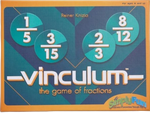
Vinculum
by Simply Fun
Ages: 8+ years
Fractions can feel slippery until something clicks — Vinculum is built to be that click. Players race to reduce and expand fractions mentally, spotting equivalents and slapping tiles before anyone else does. The math is real, but it plays like a reflex game. Designed by Dr. Reiner Knizia, a mathematician with a Ph.D. and over 800 published games, it's simple to learn and genuinely demanding to master. Up to six players, about 15 minutes a round.
Why we like it: The slap mechanic keeps everyone fully alert, built-in tile variations let difficulty scale naturally, and repeated play builds real fraction fluency — not just memorization.
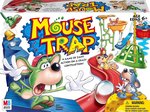
Mousetrap
by Hasbro
Ages: 6+ years
First published in 1963, Mousetrap is part board game, part Rube Goldberg machine — and it's still one of the most entertaining introductions to cause and effect ever put in a box. Players take turns building a 21-piece chain-reaction contraption: crank the gear, the shoe kicks the bucket, the ball rolls down the stairs, the diver hits the tub, the cage drops. Whether it catches a mouse or not, watching it go is half the fun. For 2–4 players.
Why we like it: The engineering is hiding in plain sight. Kids are so focused on building the trap and trying to catch each other's mice that they're absorbing cause and effect, sequential thinking, and mechanical logic the entire time. The setup process alone — assembling 21 parts in the right order — is its own quiet lesson in following instructions and spatial reasoning. A classic that earns its place on the STEM at Home list.

Rate-A-Tat Cat
by Gamewright
Ages: 6+ years
A card game of memory, strategy, and a little nerve. Players are dealt four face-down cards and try to end the round with the lowest score — collecting low-value cat cards and ditching high-value rat cards. Peek, Swap, and Draw Two power cards let players maneuver and outwit opponents, but only if they can remember where their own cards are. Fast-playing, easy to learn, and genuinely strategic. For 2–6 players.
Awards: Oppenheim Toy Portfolio Platinum Award | Mensa Select | Games Magazine Top 100 | NAPPA Honors | Major Fun Award
Why we like it: Rat-a-Tat Cat is quietly doing a lot of mathematical work — addition, memory, probability, and risk-reward thinking — wrapped in a game kids just want to play again. The rounds are short enough to fit anywhere, and the strategy runs deep enough to keep adults honest. One of those rare games that works just as well at the kitchen table as it does on a plane.

Kanoodle
by Educational Insights
Ages: 7+ years
Twelve colorful pieces, a pocket-sized case, and 228 puzzles ranging from beginner to expert. The challenge is straightforward: use the guide to set up some pieces on the board, then fit the remaining ones to solve it. In 2D or 3D. There is always exactly one solution — which makes the moment it clicks genuinely satisfying. Solo play, screen-free, and compact enough to go anywhere.
Why we like it: Kanoodle is a masterclass in spatial reasoning disguised as something you just want to fiddle with. The puzzle format is self-contained and self-correcting — kids know immediately when they've solved it and when they haven't — which makes it unusually good for independent, persistent thinking. The range from beginner to expert means it grows with the child, and the portable case means it's always within reach.