STEM at home
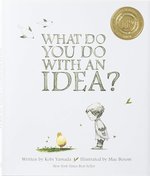
What Do You Do With an Idea?
by Kobi Yamada
Ages: 4+ years
A child has an idea — illustrated as a small golden creature that won't go away no matter how hard it's ignored. At first the child is embarrassed by it, unsure what to do with something so strange and unproven. But gradually, as the child stops running and starts paying attention, the idea grows. The illustrations move from pencil gray to full, saturated color as the child's confidence builds — a visual trick that makes the emotional journey impossible to miss. This is a book about what it feels like to have an original thought and be brave enough to follow it.
Awards: New York Times Best Seller | Independent Publishers Award Gold | Washington State Book Award Gold | Moonbeam Children's Book Award Gold
Why we like it: Every scientist, engineer, and inventor starts with an idea that probably felt too strange to share. This book gets at that feeling exactly — and makes a compelling case for nurturing what others might laugh at.
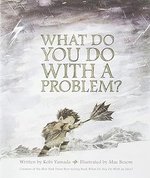
What Do You Do With a Problem?
by Kobi Yamada
Ages: 4+ years
A persistent problem shows up in a child's life and won't leave. The longer it's ignored, the bigger it seems to grow. This deceptively simple picture book follows what happens when the child finally turns to face it — and finds something unexpected inside. The illustrations shift from muted grays to vivid color as the child's relationship with the problem changes, which makes the emotional arc visible in a way that even young readers feel before they can explain it. It's a book about problem-solving, but really about the courage it takes to stop avoiding and start engaging.
Awards: New York Times #1 Best Seller | Christopher Award | National Indie Excellence Award | Mom's Choice Gold | Moonbeam Children's Book Award Gold | Goodreads Choice Award Nominee
Why we like it: The most important skill in any STEM field isn't knowing the answer — it's being willing to sit with a hard problem. This book makes that lesson feel personal, not instructional. Kids get it immediately.
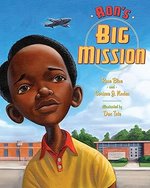
Ron's Big Mission
by Rose Blue
Ages: 6-8 years
Ron McNair loved the library. He loved books about airplanes and flight, and he went so often the librarian knew him by name. What Ron couldn't do — in South Carolina in 1959 — was check out a book. That was a rule for white patrons only. So one day, Ron walked up to the desk, put his books down, and didn't move. The police came. His mother came. He stayed. This picture book tells the true story of how a boy desegregated his library through quiet, determined resistance — and grew up to become a physicist and NASA astronaut who died aboard the Challenger in 1986. An author's note gives the full picture.
Awards: NCSS Notable Social Studies Trade Book | South Carolina Children's Book Award Nominee
Why we like it: Ron's love of flight and physics started right here, at that library desk. It's a powerful reminder that access to knowledge is never a small thing — and that kids can stand their ground and change the rules.
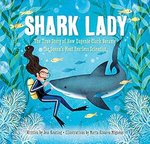
Shark Lady: The True Story of How Eugenie Clark Became the Ocean's Most Fearless Scientist
by Jess Keating
Ages: 3-7 years
Eugenie Clark fell in love with sharks at nine years old, standing at an aquarium window and refusing to look away. Most people thought sharks were mindless killers — and that women didn't belong in science. Eugenie spent her career proving both wrong: discovering new species, demonstrating that sharks could be trained, and diving into waters others wouldn't enter. This picture book biography by a zoologist-turned-author captures both the marine biology and the tenacity it took. Includes a timeline and shark facts.
Awards: ALA Notable Book | NSTA Best STEM Books for K-12 | CBC Best STEM Book | ALA Amelia Bloomer List | New York Times Best Books for Feminist Boys and Girls | Amazon Best Book of the Month | Parents Magazine Best Children's Book
Why we like it: Eugenie Clark changed how the world understands sharks — and she did it while being told repeatedly that women didn't belong in the field. Both parts of that story matter, and this book holds them together well.
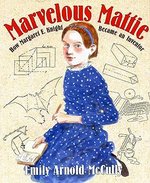
Marvelous Mattie
by Emily Arnold McCully
Ages: 7-11 years
Mattie Knight kept a sketchbook labeled My Inventions and rarely put it down. At twelve, she designed a safety guard for textile looms after watching a shuttle fly off and injure a coworker. As an adult, she invented the machine that makes flat-bottomed paper bags — the kind still used today. When a man tried to steal her patent, claiming she could not possibly understand the mechanical complexities, she took him to court and won. This picture book biography captures an inventor who saw problems and fixed them before anyone thought to ask her to.
Awards: Bank Street Best Children's Book of the Year | Publishers Weekly Starred Review | The Horn Book Starred Review | Texas Bluebonnet Award Master List
Why we like it: Mattie Knight is one of the most prolific inventors in American history and almost nobody knows her name. The problem-solving here is real and concrete — she didn't just dream big, she built things that worked, filed 27 patents, and earned the nickname the Lady Edison.
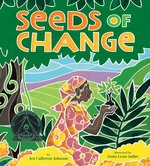
Seeds of Change: Planting a Path to Peace
by Jen Cullerton Johnson
Ages: 6-11 years
Wangari Maathai grew up in Kenya loving the land — the trees her people revered, the tadpoles in the river, the science she excelled at when most girls weren't allowed in school. She studied in the United States, returned home, and started planting trees one at a time, until the number reached 30 million. In 2004, she became the first African woman — and first environmentalist — to win the Nobel Peace Prize. This picture book biography captures her scientific grounding in ecology and the courage it took to act on it.
Awards: Coretta Scott King/John Steptoe Award for New Talent | ALA Amelia Bloomer List | Children's Africana Book Award | Green Earth Book Award Honor | Kirkus Reviews Starred Review
Why we like it: Wangari Maathai's story connects environmental science, ecology, and civic courage in a way that's rare in picture books. The idea that planting trees could change a country — and win the Nobel Prize — is exactly the kind of thinking we want kids to sit with.
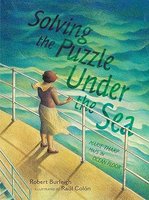
Solving the Puzzle Under the Sea: Marie Tharp Maps the Ocean Floor
by Robert Burleigh
Ages: 4-8 years
Marie Tharp's father was a mapmaker, and she inherited the obsession. What she did with it changed science: she became the first person to map the floor of the Atlantic Ocean, producing evidence that helped prove plate tectonics. Nobody thought it was possible — and when she tried, she was turned away from research ships because a woman on board was considered bad luck. This picture book biography, told in Marie's own imagined voice, captures both the science of ocean cartography and the tenacity it took to do the work. Colón's watercolor illustrations are a perfect match.
Awards: ALA Notable Book | NY Public Library Best Books for Kids | NSTA Outstanding Science Trade Book | NSTA Best STEM Books for K-12 | Kirkus Prize Nominee | School Library Journal Starred Review | Kirkus Reviews Starred Review
Why we like it: Plate tectonics is one of the most important ideas in Earth science, and most kids have no idea a woman's map helped prove it. This book fixes that — beautifully.
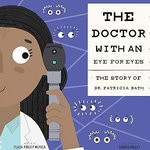
The Doctor with an Eye for Eyes: The Story of Dr. Patricia Bath (Amazing Scientists Book 2)
by Julia Finley Mosca
Ages: 4-9 years
Patricia Bath grew up during the Civil Rights Movement, facing racism, poverty, and sexism at every turn — and became a doctor anyway. This rhyming picture book biography tells the story of how she never lost sight of her goal, ultimately inventing a groundbreaking laser treatment that restored vision to people who had been blind for decades. Like the other books in the Amazing Scientists series, it includes a full biography, timeline, fun facts, and a note from Dr. Bath herself. It's a story about scientific innovation and about what it takes to keep going when the world keeps telling you no.
Awards: NSTA Best STEM Books for K-12 | Chicago Public Library Best of the Best | A Mighty Girl Book of the Year
Why we like it: Dr. Bath's invention — the Laserphaco Probe — is one of the most significant medical breakthroughs of the 20th century, and most kids have never heard of her. This book changes that, without ever making the history feel like a lesson.
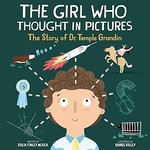
The Girl Who Thought in Pictures: The Story of Dr. Temple Grandin (Amazing Scientists Book 1)
by Julia Finley Mosca
Ages: 4-9 years
When Temple Grandin was young, doctors said she'd never speak. They were wrong. This rhyming picture book biography traces how a girl who processed the world in pictures — and thought the way animals do — grew up to revolutionize animal behavior science and transform livestock handling worldwide. Includes a full biography, timeline, fun facts, and a note from Temple herself. It's one of the few picture books that shows a real scientist's mind working differently — and treats that difference as the source of her genius.
Awards: NSTA Best STEM Books for K-12 | NSTA Outstanding Science Trade Book | Dolly Gray Children's Literature Award | A Mighty Girl Book of the Year | USBBY Outstanding Books for Young People with Disabilities
Why we like it: Temple Grandin is a genuine science hero, and this book doesn't soften her story. It's an honest, warmhearted introduction to a mind that changed how we understand animals — and what's possible when kids who think differently are supported.
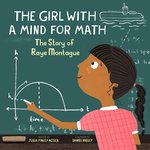
The Girl With a Mind for Math: The Story of Raye Montague (Amazing Scientists Book 3)
by Julia Finley Mosca
Ages: 5-10 years
After touring a German submarine as a girl, Raye Montague decided she was going to be an engineer. Sexism and racial inequality fought her every step of the way — and for decades, even her greatest achievement was kept secret. That achievement: using a computer to design a naval ship in record time, a first in U.S. Navy history. This rhyming picture book biography belongs alongside Hidden Figures — a gifted mathematician who changed ship design forever, working in the shadows until history caught up. Includes a biography, timeline, fun facts, and a note from Montague herself.
Awards: NSTA Outstanding Science Trade Book 2019 | NSTA Best STEM Books for K-12 2019 | 2019 Amelia Bloomer List | 2019 Mathical Honor Book
Why we like it: Raye Montague is genuinely unknown to most people — kids and adults alike. She was a computing pioneer who applied mathematics to engineering at a scale that hadn't been done before. That story deserves to be told, and this book tells it well.