STEM at home
Numberphile
Ages: 13+ years
Numberphile is a YouTube channel and podcast built on a slightly subversive idea: numbers are fascinating, and mathematicians are some of the most interesting people to listen to. Produced by video journalist Brady Haran, the videos pull in mathematicians from around the world to dig into prime numbers, infinity, famous proofs, puzzles, and the occasional bizarre calculation that takes an hour to unpack. The companion podcast slows down and lets those same guests talk about how they actually think, work, and got hooked on math in the first place. It isn't a curriculum. It's a window into how mathematicians see the world.
Why we like it: Most math content for kids stays inside the textbook. Numberphile does the opposite. It treats math as an open, ongoing human conversation. Your child sees real mathematicians puzzled, excited, and occasionally stuck, which quietly teaches the thing that matters most: math isn't about being fast. It's about being curious enough to keep going.

Mathblog.com
Ages: 13+ years
MathBlog.com is a long-running site dedicated to the idea that math is genuinely worth being interested in — not a hurdle to clear, but a body of thinking with its own beauty. Started in 2007 by software developer Antonio Cangiano and now run with contributions from a range of educators and writers, it pairs in-depth book reviews (think A Mind for Numbers, The Princeton Companion to Mathematics) with a deep reference library covering arithmetic, geometry, algebra, trigonometry, calculus, statistics, and the theorems that hold it all together. For parents trying to help with elementary math vocabulary, brush up on order of operations before homework hour, or find a book that turns math from a chore into a curiosity, it's a quiet, no-frills resource that respects the reader's intelligence.
Why we like it: It treats math as something to fall in love with, not survive. The reference pages are clear enough to help in the moment, and the book reviews point families toward titles that build real understanding — the slow, sturdy kind that lasts.

Little Bins for Little Hands
Ages: 5-10 years
Little Bins for Little Hands is one of the most useful hands-on STEM libraries on the internet, a deep collection of low-prep science, engineering, and art activities organized by season, holiday, theme, and concept. Slime chemistry, simple machines, density experiments, magnetic builds, weather projects, the kind of activities that turn a rainy Saturday into something better than another screen. Most use materials already in the kitchen or junk drawer, and each activity walks parents through the why behind the what. The free site is the entry point. From there, a Library Club and a Little Bins Club add deeper access with fresh monthly content, printable activity packs, themed bundles, and member-only resources for families who want the planning already done. A separate shop offers stand-alone printable packs and unit plans for one-time purchase.
Why we like it: It hands kids a question, not a recipe. Predict, try, watch what happens, try it again. That's the loop every strong STEM foundation is built on.
Maths and Sports
by University of Cambridge Millenium Math Project
Ages: 5+ years
Maths and Sport is a free collection of activities and articles from the University of Cambridge's Millennium Mathematics Project, built to explore real maths through real sport. Should the staggered start lines on a 400m track be where they are? Which country actually had the most athletic population at the 2012 Olympics? The activities span more than twenty Olympic and Paralympic sports and open the door to real problem-solving: data analysis, proportional reasoning, statistics, geometry, and logic. Older kids can dig in on their own; with younger ones, walk through a scenario together on the way to practice or at the dinner table.
Awards: London 2012 Inspire Mark · Part of the award-winning Millennium Mathematics Project, University of Cambridge
Why we like it: It shows kids that math isn't just something that lives in a workbook — it's how athletes train, how races are designed, and how performance gets measured. For a child who loves sport, that's the moment math starts to click.
Cities of the Future
by MacGillivray Freeman Films 2,201 posts
Ages: 6+ years
Most kids have seen a city. Few have ever been asked to imagine building one. Cities of the Future does exactly that — a 40-minute documentary following civil engineer Paul Lee as he shows what's already being built to meet a changing world. Electric flying cars, smart buildings, and solar energy beamed from space. The film travels from Los Angeles racing toward 100% renewable energy, to Amsterdam's 3D-printed steel bridge, to Singapore, where engineered Supertrees have turned a sweltering island into a sustainable oasis. Your child also meets middle schoolers in the Future City Competition, designing cities alongside real engineers. Best on an IMAX screen, but also streams on Vimeo.
Why we like it: It makes the invisible systems behind modern life — power, transit, water, buildings — suddenly visible, and frames engineering the way it actually works: define the problem, design, test, refine, repeat. Your child walks out looking at their own city differently.
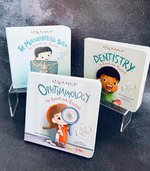
Little Doctors Children's Books Set: Volume 2: Lift-the-Flap (Ophthalmology, Dentistry & The Musculoskeletal System)
by Dr Haitham Ahmed
Ages: 2-4 years
The second set from Dr. Haitham Ahmed takes the same rhyming, illustration-rich approach and adds lift-the-flap interactivity — which means small hands stay engaged while big ideas sink in. Each book walks through a check-up from the child's point of view: symptoms, examination, treatment. Eyes, teeth, bones, and muscles get demystified through diverse characters and genuine medical vocabulary. Kids learn what to expect at a doctor or dentist visit, and parents get a natural entry point for conversations about anatomy, health, and how the body actually works.
Why we like it: Hands-on interaction is one of the most reliable ways young children learn, and these books turn a simple read-aloud into something closer to exploration. They also gently prepare kids for medical visits — lowering anxiety while building vocabulary around health, anatomy, and the science of the human body.
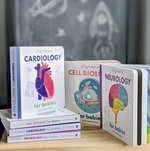
Little Doctors Children's Books Set – Volume 1 (Cardiology, Neurology & Cell Biology for Babies)
by Dr Haitham Ahmed
Ages: 2-4 years
Written by Dr. Haitham Ahmed, this board book set introduces the youngest readers to the heart, the brain, and the building blocks of life — with rhyming text, bright illustrations, and the kind of durability that holds up to real toddler handling. The vocabulary is unapologetically real: cardiologist, neuron, mitochondria. Kids won't understand every word on the first read, and that's the point. Repetition builds familiarity, familiarity builds curiosity, and curiosity is what eventually becomes real scientific interest. A quiet way to plant the seeds of biology and anatomy long before a child can spell either word.
Why we like it: Early exposure to real scientific language — not watered-down stand-ins — is one of the simplest ways to signal that science belongs in your child's world. These books do that without ever feeling like a lesson. They invite wonder about the body, which is exactly where a lifelong interest in biology, medicine, and how things work tends to begin.
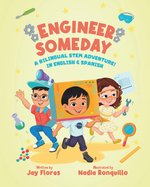
Engineer Someday: A Bilingual STEM Adventure in English and Spanish
by Jay Flores
Ages: 2-7 years
Engineer Someday is a picture book that turns the word "engineer" into something a young child can actually picture. Written by Jay Flores — who graduated as the only Latino in his mechanical engineering class — it walks through ten types of engineers, from aerospace and biomedical to software and civil, comparing each to something kids already love, like superheroes, chefs, and explorers. Kids tend to see the civil engineer page and reach for their blocks. The rhymes work in both languages, and the illustrations are bright and deliberately diverse. The goal: help your child see themselves in roles most won't hear about until much later.
Why we like it: Most kids don't know what an engineer actually does until high school — or later. This book closes that gap early, in a way that feels like play. The bilingual format is a gift for families raising curious kids in two languages, and the representation makes it easy for every child to picture themselves building or inventing.
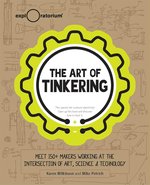
The Art of Tinkering: Meet 150+ Makers Working at the Intersection of Art, Science & Technology
by Karen Wilkinson and Mike Petrich
Ages: 8+ years
Some books tell your child what to do. This one shows them what's possible. Brought to life by the team behind the Exploratorium's Tinkering Studio, it profiles 150+ artists, engineers, and inventors working at the intersection of art, science, and technology. Toothpicks become cities. Masking tape becomes architecture. A 9-volt battery and some conductive ink turn the cover itself into a circuit.
Parents don't need a science background to use it. Flip through together, let your child pick a maker who sparks something, then grab whatever's in the junk drawer and follow their lead. Expect engineering, circuitry, mechanical design, soft electronics, and a lot of joyful problem-solving.
Why we like it: This book captures something we believe deeply — that the strongest STEM foundation is built through play, exploration, and the freedom to try, fail, and try again. It doesn't tell your child what to make. It shows them how makers think, then hands them the tools to find their own way in.

Emily's Science Lab
by Emily Calandrelli
Ages: 5-12 years
Emily's Science Lab is the ongoing YouTube home of Emily Calandrelli, the MIT-trained engineer known as "The Space Gal." New videos arrive regularly — hands-on chemistry, physics, and engineering experiments explained in plain language, using materials most families already have in the kitchen or garage. Emily shows her work: she names the concept, runs the experiment, walks through safety, and explains what just happened and why.
If your child first met Emily through her Netflix series, Emily's Wonder Lab, this is where the same spirit keeps going — without a finale.
Why we like it: It's a living resource rather than a finite series. Free, family-friendly, and built around household materials rather than kits, it's the kind of thing you can pull up on a rainy Saturday without a trip to the store — and the library keeps growing.