STEM at home

Rule Breakers
by Angel Studios
Ages: 10+ years
Based on the true story of Afghanistan's first all-girls robotics team, this PG drama follows students building a competition robot from salvaged parts while navigating Taliban-controlled streets and visa denials. Before any official kit arrived, the team sourced scrap materials and taught themselves engineering basics, the kind of resourceful iteration that defines how engineers actually work. Co-written by one of the women portrayed, the film centers Afghan girls as brilliant and courageous, not as victims. The content is heavy: a mosque bombing and armed confrontations are depicted, and parents should preview before watching with sensitive children. Now streaming on Angel Studios; available to rent or buy on major VOD platforms.
Why we like it: It shows girls doing real engineering under impossible constraints, demonstrating how engineers actually think: identify the problem, use what you have, iterate, persist. Representation and authentic process in one film is rare.

ChessUp 2 Smart Chess Board
by Bryght Labs
Ages: 7+ years
Chess is hard to learn, and that's the problem ChessUp 2 is built to solve. Touch sensors and LEDs in every square light up legal moves the moment a piece is lifted. Color coding shows move quality, and assistance can be dialed down or off entirely as skill develops. The companion app syncs with the board so lessons play out physically, and connects to Chess.com for rated play without a phone on the table.
At around $350, this is a real investment. It earns that price for families where a child has shown genuine interest in chess, or where the board will see repeated use. If you are testing whether chess clicks at all, a standard set and a free app is the smarter starting point.
Why we like it: Chess trains the habit of holding multiple outcomes in mind and revising a plan when new information arrives. The board's adjustable scaffolding keeps that cognitive work intact while removing the legal-move memorization barrier that stops most beginners before they reach actual strategy.

Bridge or Bust: The Ultimate Bridge-Building Adventure
by Upper Story
Ages: 8+ years
Each of 61 challenges asks your child to build a bridge satisfying three simultaneous constraints: span length, load capacity, and clearance height for a sailboat to pass beneath. Those are actual structural engineering variables. The kit teaches them through testing and iteration, not instruction. When a bridge fails, the pieces snap back together in seconds. That fast reset is intentional: it removes the friction that usually punishes failure and makes iteration the natural rhythm of play.
One honest heads-up: initial setup requires attaching roughly 200 small clips before the first puzzle, which can take an hour or more. Plan for that. This kit also sells direct through the manufacturer only, with no Amazon presence.
Awards: NAPPA Awards Winner, 2026.
Why we like it: It trains the habit of holding multiple constraints in mind at once, which is closer to real engineering reasoning than most building kits get. Your child is not just building, they are learning to manage tradeoffs.

Turing Tumble
by Upper Story
Ages: 8+ years
A marble-powered mechanical computer built from ramps, bits, and gear bits, Turing Tumble teaches how computers work: no screen, no battery, no code. Players work through 60 puzzles woven into a comic-book story, building configurations that direct red and blue marbles in specified patterns. Puzzles introduce binary logic, if/else relationships, and iterative debugging, adding piece types as complexity grows. Developed by a former university professor with a programming background who built it to address his students' struggles with computational thinking.
Awards: 2018 Parents' Choice Gold Award; 2018 ASTRA Best Toys for Kids Award; 2019 Toy of the Year Finalist; NAPPA Award Winner
Why we like it: The puzzle structure mirrors real debugging. Build a configuration, run it, see what breaks, revise. Children practice forming a hypothesis about why a solution failed, then testing a fix. That loop is what computational thinking looks like in practice, and it transfers well beyond this board.

Spintronics
by Upper Story
Ages: 8+ years
Circuits are invisible until you build one. Spintronics changes that. Players construct mechanical circuits using sprocketed gears, chains, and components representing batteries, resistors, capacitors, and switches. The chains stand in for wires; a pull cord drives the current. When it works, you see it. When it doesn't, you see that too. Act One covers core electrical engineering across 67 puzzles and is the required starting point. Act Two, sold separately, adds transistors and inductors with 82 more puzzles from intermediate to advanced. A free simulator is available on the Upper Story site.
One honest flag: the chain links are small and fiddly. Adult co-play is realistic for younger children.
Why we like it: Spintronics builds causal reasoning about circuits, requiring children to predict how a configuration will behave, test it, and adjust. The feedback is immediate and physical, not abstract. That loop of hypothesis and revision is how engineers actually think.

Amazing Inventions That Changed The World: The True Stories About The Revolutionary And Accidental Inventions That Changed Our World
by Bill O'Neill
Ages: 6-12 years
Ten inventions. Ten stories about what humans do when they run into a problem they can't ignore. This book walks through the history of paper, the compass, the printing press, the steam engine, electricity, vaccines, refrigeration, the airplane, penicillin, and the computer — not as a parade of eureka moments, but as a record of iteration, accident, and persistence. Each chapter traces what came before, what changed, and why it mattered. The writing is accessible, with sidebar facts that reward curious readers who want to go deeper.
Why we like it: The book frames invention as a process rooted in need and failure — not in genius alone. That's a useful frame for children learning to stick with a problem, and for parents looking for concrete examples of engineering thinking and scientific reasoning in action.
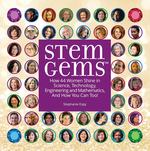
STEM Gems: How 44 Women Shine in Science, Technology, Engineering and Mathematics, and How You Can Too!
by Stephanie Espy
Ages: 13+ years
A collection of profiles of 44 women working across science, technology, engineering, and mathematics, this book makes the breadth of STEM careers visible in a way most kids never encounter. Each woman's story covers her path, the obstacles she navigated, and what her day-to-day work actually looks like. The career range is wide: chemical engineering, data science, aerospace, biomedical research, and more. It's written for girls and young women, but parents find it genuinely useful too, as a conversation starter and a reference for what's possible beyond the handful of STEM careers that tend to get all the attention.
Why we like it: It builds career imagination, the habit of picturing yourself doing something before you've been formally invited to try. That's a skill, and it's one of the quieter things STEM readiness depends on.

Queen of Leaves: The Story of Botanist Ynes Mexia
by Stephen Briseño
Ages: 6-8 years
A picture book biography of a plant scientist who refused to let convention stop her. Ynes Mexia came to botany later in life, at a time when women were rarely welcomed in field science. She went on to lead expeditions across Mexico, Central America, and South America, ultimately collecting nearly 150,000 specimens, discovering more than 500 new species, and naming a new genus entirely her own. The book uses the wax palm as a parallel narrator, threading Mexia's story through the biology of a plant that also survived against the odds.
Awards: NSTA Outstanding Science Trade Book, 2024
Why we like it: The parallel structure asks children to hold two ideas at once: a scientist's life and a plant's survival strategy. That kind of comparative thinking, weighing two systems side by side to find what they share, is a genuine scientific habit of mind. The scale of Mexia's real work also gives kids something concrete to sit with: 150,000 specimens is a number worth thinking about.

Backyard Brains
Ages: 10+ years
These kits put real neuroscience into kids' hands. Devices in the product line record actual electrical signals from muscles, hearts, brains, and plants. The Human SpikerBox lets students visualize their own muscle and heart signals in real time. Other kits cover plant signaling, reflex testing, and neuroprosthetics. Each ships with free, grade-leveled experiment guides aligned to NGSS and AP frameworks. The science is not simulated: students record live data and design their own experiments. The line runs from entry-level kits to brain-computer interface experiments.
Awards: Champion of Change for Citizen Science (White House); Next Generation Award (Society for Neuroscience); NIMH Director's Award; 4 NIH research grants.
Why we like it: Most STEM kits teach kids about science. These ask them to practice it. The structure builds genuine hypothesis-testing: record a baseline, manipulate a variable, compare results. That's the scientific method, not a worksheet version of it.

ChompSaw by Chompshop
Ages: 5+ years
Cardboard is everywhere, and your child has probably looked at a box and imagined something better. The problem has always been the cutting. The ChompSaw by Chompshop lets kids cut cardboard on their own, using a hole-punch mechanism instead of a blade, with an opening too small for fingers. It handles straight lines, curves, and shapes through cardboard, craft foam, and fabric, on a work surface with built-in measuring and angle guides. One honest note: the tool is loud, so noise-sensitive children may want ear protection. The Inventor's Club subscription (sold separately) adds monthly guided project packs.
Awards: TIME Best Inventions 2025; TOTY Creative Toy of the Year 2026
Why we like it: Once a child can cut cardboard on their own, the design loop closes. They plan a structure, build it, see where it fails, and try again without waiting for help. That cycle of spatial planning, iteration, and physical problem-solving is where engineering thinking gets built.